5 posts tagged with "Show case"

View All Tags

Showcase: a layered approach to creating interoperable Digital Battery Passports


· 13 min read
Jelte Bootsma (TNO)
Expert semantic interoperability
Wouter van den Berg (TNO)
Expert semantic interoperability & Scrum master

From 18 February 2027, the EU Battery Regulation requires a digital product passport (DPP) for electric vehicle batteries, batteries for light means of transport (such as e-bikes and e-scooters) and industrial batteries above 2 kWh. For manufacturers and their software vendors, the question is no longer whether to build one, but how to build it correctly and in a way that others can actually use.

A passport can contain all the required information and still be difficult to exchange or process automatically, because different organisations use different names, structures and interpretations for the same battery data.

To prevent this, several parties each define a part of the DPP: the European Commission and industry define generic concepts, sector organisations add battery-specific concepts, and experts translate the requirements into machine-readable rules. These parts have to fit together. Within CIRPASS-2, we developed a Battery DPP Template that shows how these contributions come together in one concrete, machine-validatable DPP, and how Semantic Treehouse turns that template into implementation support. The approach follows the semantic architecture that the European Commission describes in the DPP Registry Semantic Data Guide (v1.0, October 2026).

This showcase is written for two groups. If you are involved in DPP standardisation, it shows how the layers and the parties behind them fit together. If you are an IT architect at a manufacturer or another party that must provide a DPP, it shows how your Battery DPP can be compliant, using an EV battery as an example.

Batteries are just one example. The same approach can be applied to other product groups. Are you curious how this could work for your sector? Get in touch via Discord or mail Linda Oosterheert.

User Experience: SETU Planning and Schedulling standard

· 3 min read
Jelte Bootsma (TNO)
Expert semantic interoperability

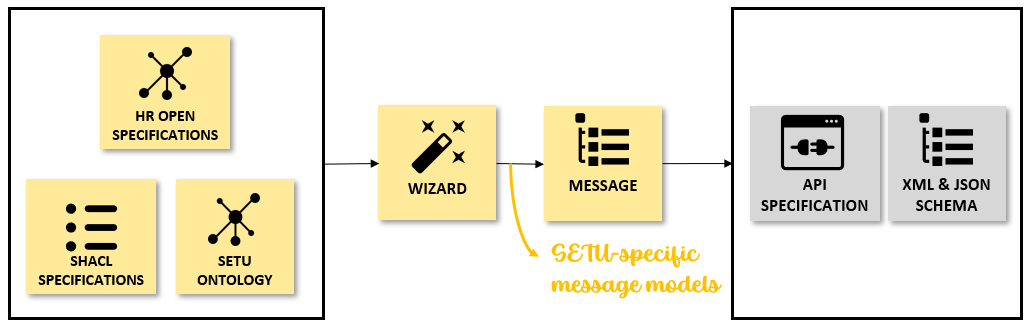
This blog post will address how Semantic Treehouse supported the needs of a data sharing community in creating a new standard. Among the dedicated users of Semantic Treehouse is the SETU foundation, the organization for data standardization of the flexible staffing industry in the Netherlands. Recently, SETU developed the Planning and Scheduling standard, enabling seamless data exchange of planning information between staffing suppliers back-office software, planning tools, and interconnecting planning tools.

For this Planning and Schedulling standard, there was a desire to repurpose HR Open specification whenever feasible. This involved creating multiple message models by carefully selecting elements from the HR Open Model in JSON Schema and incorporating SETU specific additions and restrictions. Furthermore, SETU's goal was also to create schemas in both JSON and XML formats, along with Open API specifications for seamless implementation and validation. The following text highlights how Semantic Treehouse supported the SETU foundation in reaching their goals.

Ketenstandaard Bouw en Techniek

· 12 min read

"With Semantic Treehouse we are able to quickly and easily develop new message specifications and APIs" says Luuk d’Hooghe. Luuk is standardization manager at Ketenstandaard Bouw en Techniek. Since 2019, Ketenstandaard has been using the Semantic Treehouse platform for publishing and managing, among other things, the DICO standard. We spoke to Luuk to hear how they use the platform and what added value it offers their community.

Ketenstandaard Bouw en Techniek

SETU | Standards for flexible staffing

· 10 min read

"Semantic Treehouse supports us in making the step towards a syntax independent data model that can be expressed in both XML and JSON"

Kevin Boumans is a software architect at employment agency Driessen. When exchanging data between the various parties, they use the SETU standards, just like many other agencies. Kevin is also a board member of the SETU. We had a talk with Kevin to hear from both perspectives what his experiences are with the Semantic Treehouse platform.

info

The SETU foundation was established in 2007 to provide the temporary employment sector with standards for electronic messaging between temporary workers and their hirers. SETU is one of the communities that created the need for Semantic Treehouse to publish online and support the standardization process of the SETU standards. For more information: www.setu.nl.

SETU